Video Wall Controllers: Daisy-Chains, Dedicated Processors & Embedded SOCs
Building high-impact video wall matrices requires careful coordination across scaling, timing synchronization, and signal distribution. When combining multiple 55-inch commercial display panels into a unified 3×3 or 4×4 canvas, AV system engineers must evaluate three primary processing topologies: onboard DisplayPort daisy-chaining, integrated System-on-Chip (SOC), or external rack-mounted FPGA video processors.
Topology Comparison: Hardware Tradeoffs
1. Loop-Through DisplayPort 1.4 Daisy-Chains
The simplest multi-screen topology utilizes DisplayPort In and DisplayPort Out ports built into commercial monitors. A single 4K60 video source feeds the primary panel, which crops and renders its designated quadrant before transmitting the remaining stream down the chain.
- Advantages: Minimizes hardware expenses by eliminating external distribution amplifiers, matrices, or dedicated video wall processors.
- Limitations: Limited to static aspect ratios (e.g., 2×2 grid from a 16:9 canvas). Additionally, frame latency accumulates down the chain, occasionally causing visible frame tearing between the first and last panel without hardware genlock.
2. Embedded System-on-Chip (SOC) Platforms
Modern commercial signage displays integrate multi-core ARM application engines and hardware video decoders directly into the internal chassis (such as Samsung Tizen SSSP, LG webOS Signage, or Android Enterprise modules). The panel acts as an autonomous media decoder, streaming synchronized video streams over local Gigabit Ethernet.
- Advantages: Eliminates external HDMI cables, mounting brackets, and external power adapters behind the display. Cleanest physical deployment for retail spaces and corporate lobbies.
- Limitations: Firmware updates depend on the panel manufacturer. Processing overhead is limited when decoding multi-layer 8K feeds or rendering dynamic real-time WebGL content.
3. External Hardware FPGA Video Wall Processors
For mission-critical network operations centers (NOCs), air traffic management facilities, and broadcast studios, dedicated chassis processors (such as Datapath or Extron systems) are standard. These rackmount appliances handle scaling, windowing, and frame synchronization in hardware using field-programmable gate arrays (FPGAs).
- Sub-Millisecond Genlock: Guarantees all video outputs fire their vertical blanking intervals simultaneously, preventing motion tearing during horizontal pans across display seams.
- Arbitrary Multi-Windowing: Allows operators to float dozens of independent video, telemetry, and camera sources across panel boundaries with zero scaling latency.
| Architecture Feature | DisplayPort Daisy-Chain | Embedded SOC Solution | Dedicated FPGA Controller |
|---|---|---|---|
| Hardware Complexity | Low (Cables only) | Lowest (Single Cat6 cable) | High (Rackmount processor required) |
| Frame Synchronization | Moderate (Variable skew) | NTP / Network Genlock | Hardware Clock Genlock (<1ms) |
| Layout Flexibility | Grid only (2×2, 3×3) | Software defined zones | Unrestricted multi-windowing PIP |
| Deployment Cost | Economical | Moderate | Enterprise Capital Grade |
Bezel Compensation and Geometric Calibration
Even ultra-narrow bezel panels (0.88mm to 1.8mm combined bezel-to-bezel border) interrupt visual continuity across continuous vectors. Uncompensated image streams cause diagonal lines to appear bent or offset as they cross the bezel seam.
Commercial video processors and display logic cards integrate Bezel Mask Compensation. The system calculates the physical width of the metal border and conceals the corresponding pixel rows behind the seam, preserving straight diagonal lines and geometric fidelity across the entire canvas.
Mounting Infrastructure and Push-to-Eject Systems
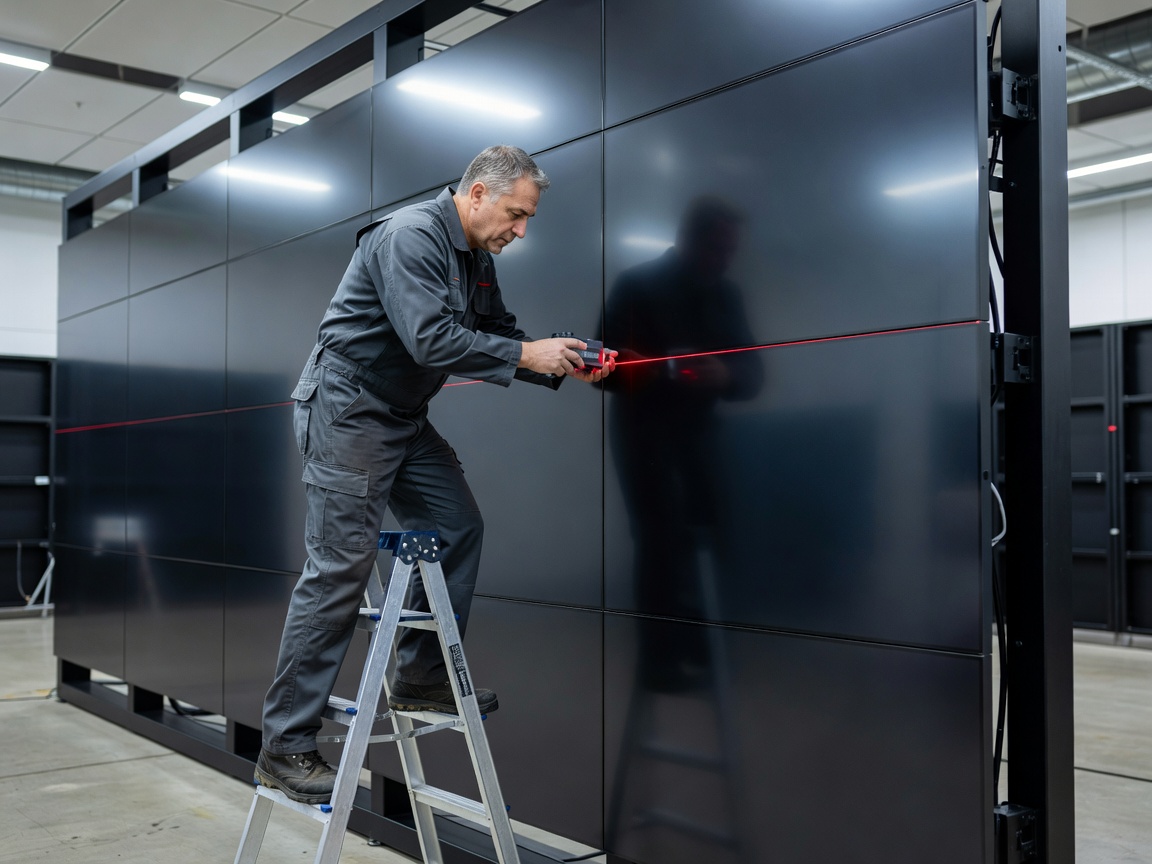
Mechanical stress is a frequent cause of panel damage in video wall installations. A 3×3 matrix of 55-inch panels weighs over 200 kilograms. Precision pop-out mounts with multi-point micro-adjustments along the X, Y, and Z axes are critical. This allows technicians to align display faces flush while maintaining a 0.5mm expansion gap between glass borders, preventing thermal expansion from chipping adjacent panels.